PLC Relays & Indicator Lamps
INTRO
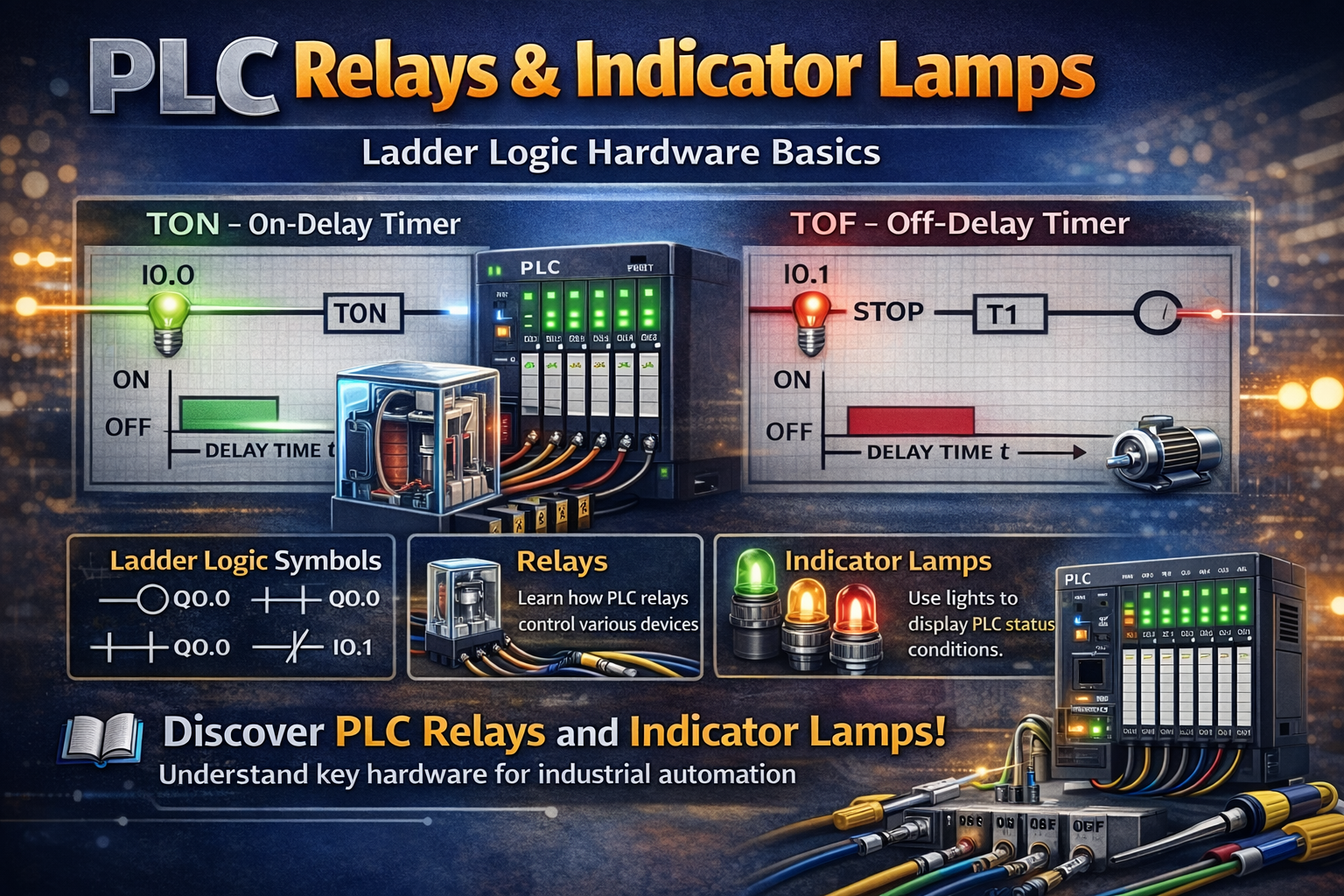
PLC relays and indicator lamps are key hardware components in industrial automation systems. They connect control logic with real-world devices and provide visual feedback to operators.
In this guide, you will learn how relays work and how indicator lamps are used in ladder logic and control panels.
🧠 PLC RELAYS AND INDICATOR LAMPS BASICS
PLC relays and indicator lamps form the bridge between control systems and physical equipment. Engineers use these components to control outputs and monitor system status.
For example, relays switch electrical circuits, while indicator lamps display system conditions. As a result, operators can quickly understand machine states.
⚙️ HOW RELAYS WORK
Relays operate using an electromagnetic principle. When current flows through the coil, it creates a magnetic field that moves a plunger.
This movement changes the state of contacts, allowing or stopping current flow. Therefore, relays can control higher-power circuits using low-power signals.
🔧 NO AND NC CONTACTS
Relays use normally open (NO) and normally closed (NC) contacts. These contacts define how circuits behave under different conditions.
For instance, a normally open contact closes when activated, while a normally closed contact opens. Because of this, engineers can design flexible control logic.
💡 INDICATOR LAMPS AND COLORS
Indicator lamps provide visual feedback in control panels. Engineers use different colors to represent system states.
Common examples include:
- Red for faults or critical conditions
- Green for normal operation
- Amber for warnings or intermediate states
Therefore, proper color usage improves safety and operator awareness.
🔄 RELAYS VS CONTACTORS
Relays and contactors have similar functions but different applications. Small relays are used for control logic, while contactors handle higher power loads.
As a result, engineers choose the correct component based on system requirements.
🌍 WHY THESE COMPONENTS ARE IMPORTANT
Understanding PLC relays and indicator lamps is important because they are essential for system control and monitoring. Without them, automation systems cannot interact with real devices.
Therefore, learning these basics helps you design reliable and safe industrial systems.
🏭 REAL APPLICATIONS
These components are used in many industrial systems. For example:
- Control panels
- Machine automation
- Safety systems
- Process industries
In addition, they improve system visibility and control accuracy.
🔗 RELATED TOPICS
✅ CONCLUSION
PLC relays and indicator lamps are fundamental elements of industrial automation. By understanding how they work, you can design systems that are both effective and easy to operate.
Over time, this knowledge will help you build more advanced and reliable control systems.
✅ Social platforms
Subscribe in out Youtube channel for more videos:
- PLC Programming YouTube Channel: https://nuel.ink/9YxAHA
- Mitsubishi Training YouTube Channel: https://nuel.ink/2eFPGR
Follow us on Social Media:
- LinkedIn: https://nuel.ink/e6ZxM2
- Facebook Page: https://nuel.ink/xh5xhN
- Facebook Group: https://nuel.ink/aYciCv
- Instagram: https://nuel.ink/JSAjeD
- Twitter: https://nuel.ink/QGXW2L
- E-mail: info@plc-courses.com