S7-1200 & S7-1500 Controller Architecture Explained
INTRO
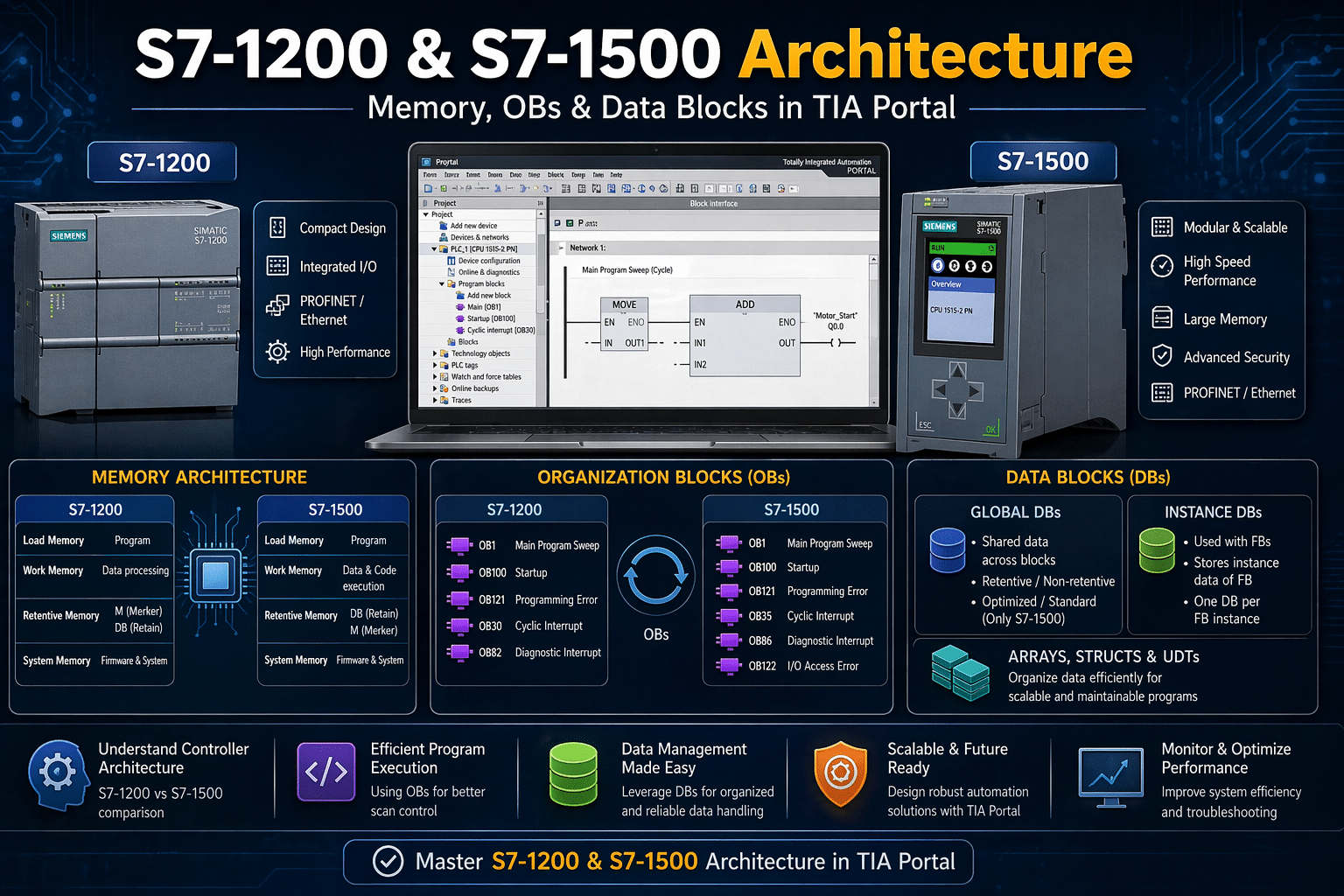
S7-1200 and S7-1500 controllers form the core of many automation systems. Their architecture defines how programs run, how data is stored, and how processes are controlled.
In this guide, you will learn how controller architecture works and how it affects PLC programming.
🧠 Controller Architecture Overview
SIMATIC controllers use a structured architecture to manage automation tasks. The system separates firmware functions from the user program.
For example, the firmware handles system operations, while the user program controls the process. As a result, execution remains stable and predictable.
⚙️ Organization Blocks (OBs)
Organization Blocks act as the interface between the system and the user program. They define when and how the PLC executes logic.
For instance, OB1 runs cyclically and processes the main program. Therefore, it controls the continuous operation of the system.
🔧 Memory Structure
Controllers use different memory areas to manage data and programs.
- Load memory stores project data
- Work memory processes the running program
- Retentive memory keeps values after power loss
Because of this structure, the system can manage data efficiently and reliably.
🔄 Process Image
The controller uses a process image for inputs and outputs. It reads inputs, processes logic, and then updates outputs.
For example, signals are handled in a defined cycle. As a result, program execution remains consistent.
🧩 Data Blocks and Storage
Data Blocks store program data and variables. Engineers can organize information in a structured way.
For instance, optimized data blocks improve memory usage and reduce errors. Therefore, programs become more efficient.
🔍 Symbolic Addressing
TIA Portal uses symbolic addressing instead of fixed memory addresses. Engineers can work with names instead of numbers.
Because of this, programs are easier to read and maintain.
🌍 Why Controller Architecture Is Important
Understanding controller architecture is essential for efficient programming. It helps engineers design reliable and scalable systems.
Therefore, knowledge of memory and execution behavior improves overall performance.
🏭 Real Applications
Controller architecture is relevant in many systems. For example:
- Machine automation
- Process control
- Data handling systems
- Industrial production lines
In addition, it supports stable and predictable operation.
🔗 RELATED TOPICS
✅ CONCLUSION
TIA Portal PLC programming provides powerful tools for developing automation logic. By using different languages and simulation tools, engineers can build and test systems efficiently.
Over time, this knowledge helps create reliable and scalable automation solutions.
✅ Social platforms
Subscribe in out Youtube channel for more videos:
- PLC Programming YouTube Channel: https://nuel.ink/9YxAHA
- Mitsubishi Training YouTube Channel: https://nuel.ink/2eFPGR
Follow us on Social Media:
- LinkedIn: https://nuel.ink/e6ZxM2
- Facebook Page: https://nuel.ink/xh5xhN
- Facebook Group: https://nuel.ink/aYciCv
- Instagram: https://nuel.ink/JSAjeD
- Twitter: https://nuel.ink/QGXW2L
- E-mail: info@plc-courses.com