PLC Switches Explained
INTRO
PLC switches are essential input devices used in industrial automation systems. They allow operators and machines to send signals to the PLC and control system behavior.
In this guide, you will learn how different types of switches work and how engineers use them in ladder logic and machine control.
🧠 TYPES OF PLC SWITCHES
PLC switches include several types of input devices used in automation systems. Each type has a specific function depending on the application.
Common switch types include:
- Push buttons
- Limit switches
- Selector switches
- Emergency stop switches
For example, push buttons allow manual control, while limit switches provide automatic feedback from machines.
⚙️ PUSH BUTTONS AND CONTACT TYPES
Push buttons are widely used in control panels. Engineers use them to start, stop, or control machines.
There are different types of push buttons:
- Momentary switches
- Maintained (push-push) switches
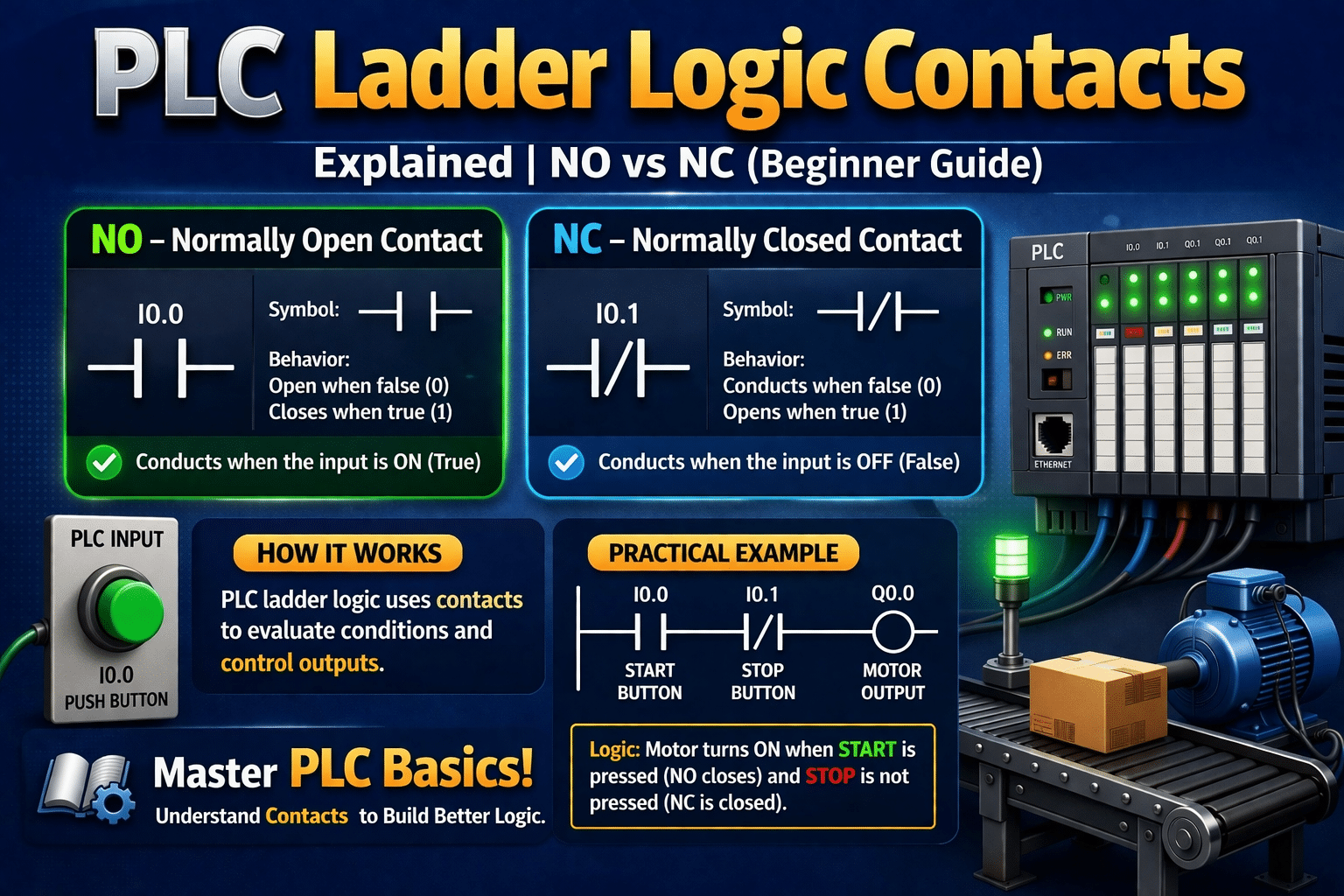
In addition, switches use normally open (NO) and normally closed (NC) contacts. Therefore, understanding these contact types is essential for designing control logic.
🔧 LIMIT SWITCHES AND FEEDBACK
Limit switches provide automatic feedback based on machine position. They detect movement and trigger signals when a specific condition is reached.
For example, a limit switch can detect when a conveyor reaches its end position. As a result, the PLC can react and control the next step.
🔄 SELECTOR AND ROTARY SWITCHES
Selector switches allow operators to choose between different modes of operation. These switches often have multiple positions.
For instance, a selector switch can control manual and automatic modes. Because of this, they are important in flexible automation systems.
⚠️ EMERGENCY STOP SWITCHES
Emergency stop switches are critical for safety. Engineers design them to immediately stop machines in dangerous situations.
Typically, these switches use a mushroom head design and a locking mechanism. Therefore, they ensure safe operation in industrial environments.
🌍 WHY PLC SWITCHES ARE IMPORTANT
PLC switches are important because they act as the interface between humans, machines, and control systems. Without them, PLCs cannot receive input signals.
Therefore, understanding these devices helps you design reliable and safe automation systems.
🏭 REAL APPLICATIONS
Engineers use PLC switches in many applications. For example:
- Control panels
- Conveyor systems
- Machine automation
- Safety systems
In addition, they improve system control and operator interaction.
🔗 RELATED TOPICS
✅ CONCLUSION
PLC switches are essential components in automation systems. By understanding how push buttons, limit switches, and selector switches work, you can design effective control systems.
Over time, this knowledge will help you build safer and more efficient automation solutions.
✅ Social platforms
Subscribe in out Youtube channel for more videos:
- PLC Programming YouTube Channel: https://nuel.ink/9YxAHA
- Mitsubishi Training YouTube Channel: https://nuel.ink/2eFPGR
Follow us on Social Media:
- LinkedIn: https://nuel.ink/e6ZxM2
- Facebook Page: https://nuel.ink/xh5xhN
- Facebook Group: https://nuel.ink/aYciCv
- Instagram: https://nuel.ink/JSAjeD
- Twitter: https://nuel.ink/QGXW2L
- E-mail: info@plc-courses.com